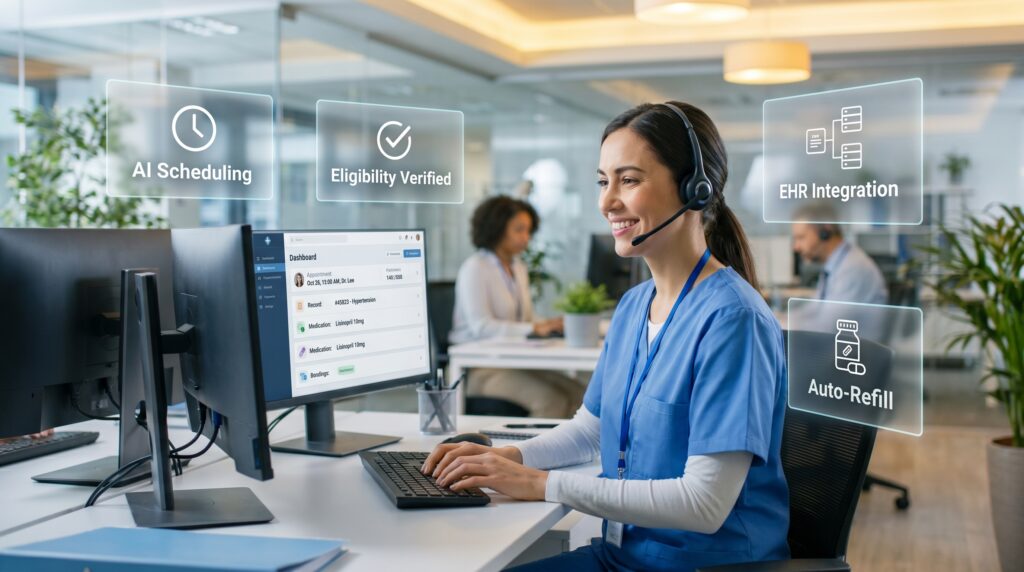
Healthcare leaders are investing heavily in AI-powered contact centers—but most are solving the wrong problem. Faster call handling. Lower wait times. Better agent productivity. Those are improvements. But they’re not transformation. Because the real issue isn’t the call—it’s the workflow wrapped around it. The Real Problem Isn’t Volume—It’s Access Every patient interaction is a moment of risk: A missed call Read more…
Medical Software Integration: How to Connect EHR, EMR, and Healthcare Systems
About 9 in 10 U.S. hospitals enabled patients to access their health information through APIs, while 7 in 10 used standards-based APIs such as HL7 FHIR for patient access. At the same time, most hospitals were already exchanging data between EHRs and third-party systems for clinical and administrative purposes. However, much of this exchange still Read more…
How EHR Systems Are Transforming Care in Mental Health Rehab Programs
Mental health care has always depended on detail: a patient’s history, their response to therapy, small changes in mood or behavior over weeks of treatment. For years much of that detail lived in paper charts, scattered notes, and disconnected systems. Electronic health records (EHRs) are changing that, and nowhere is the impact more meaningful than Read more…
How Practice Management Software Keeps Intensive Outpatient Programs Running Smoothly
Intensive outpatient programs (IOPs) occupy a unique space in behavioral health. They offer far more structure than weekly therapy, yet patients still go home each day, keep working, and stay connected to family life. That balance is what makes the model so effective for patients, and it is also what makes it operationally demanding for Read more…
How Practice Management Software Supports Family Nurse Practitioner-Led Primary Care Practices
Family nurse practitioners running their own primary care practices take on a dual role that physicians in larger organizations rarely face alone: full clinical responsibility paired with full operational ownership. Scheduling, billing, patient communication, and compliance all fall under the same roof, often with a smaller support staff than a comparable physician-led practice. Practice management Read more…
How Revenue Cycle Management Supports Family Nurse Practitioner-Led Practices
Family nurse practitioners are increasingly leading their own independent practices, particularly in states with full practice authority, taking on not just clinical responsibility but the full weight of running a healthcare business. Among the operational challenges that come with this shift, revenue cycle management is often the one that determines whether a practice stays financially Read more…
How AI Medical Scribes Support Acute Care Nurse Practitioners in High-Acuity Settings
Acute care nurse practitioners work in some of the most time-pressured environments in healthcare, managing critically ill patients where clinical decisions happen fast and documentation often gets pushed to the margins of an already demanding shift. In these settings, AI medical scribes are beginning to serve a genuinely practical role, not as a convenience, but Read more…
How AI Medical Scribes Are Reducing Documentation Burden for Nursing Teams
As healthcare organizations adopt AI, documentation has become one of the clearest places where the technology is changing daily clinical work. For nurses and nurse leaders, AI medical scribes are among the most tangible applications, and they require no one to become a data scientist to benefit. Data from the Assistant Secretary for Technology Policy Read more…
How EHR Medication Management Improves Clinical Accuracy and Healthcare Workflows
Electronic health records (EHRs) have changed the way healthcare providers manage patient information. Instead of depending on paper files and disconnected records, healthcare practices can use a centralized digital system to document patient histories, medications, allergies, prescriptions, diagnoses, and other clinical information. One important part of an effective EHR is medication management. Accurate medication records Read more…
The Best Medical Practice Management Software for Compliance and Efficiency
Running a modern medical practice requires more than providing quality patient care. Practices must manage appointments, billing, patient records, staff workflows, insurance processes, documentation, and compliance requirements while keeping daily operations efficient. The right medical practice management software can bring these activities together in one centralized system, helping practices reduce administrative work and improve operational Read more…