Few compounds have moved through gym forums and recovery circles as fast as BPC-157. It is pitched as a shortcut to healing strained tendons, sore joints, and stubborn gut issues, and that reputation is why questions about BPC-157 dosage show up constantly in training communities. The honest picture is more complicated than the hype, and worth understanding before you take anything seriously.
BPC-157 is a synthetic peptide based on a short sequence found in a protein in human gastric juice. In the lab, researchers have studied it for a range of tissue-repair effects, which is where the recovery reputation comes from. The key phrase is “in the lab”: most of what is known comes from cell and animal studies, not large human trials.
That gap between promising animal data and proven human benefit is exactly why supervision matters. Physician-led clinics such as Robertson Wellness & Aesthetics treat peptides as something to evaluate case by case, with a medical history and a frank conversation about what is and is not established, rather than a supplement to grab online. For an athlete, that distinction is not just about results – it can affect eligibility to compete.
What BPC-157 is, and what it is not
BPC stands for “body protection compound,” and 157 refers to the specific fragment. It is a manufactured peptide, not a vitamin or a food, and it is not an approved medicine in the United States. No BPC-157 product has been cleared by the FDA for human therapeutic use.
That status shapes everything downstream. Without approval, there is no standardized dose, no regulated manufacturing, and no quality guarantee for products sold through gray-market channels. Purity and labeling accuracy become real concerns.
What the research actually shows
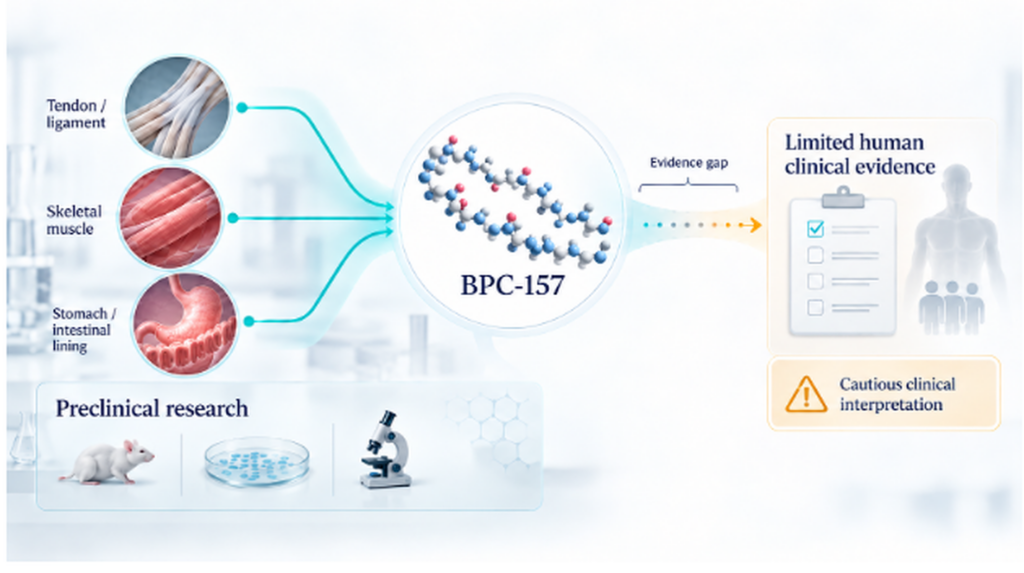
Preclinical studies indexed by the U.S. National Library of Medicine report signals around tendon, ligament, muscle, and gut-tissue repair in animal models. Those findings are genuinely interesting and are why the compound is studied at all. They are not the same as proof that it works the same way, at the same doses, in humans.
Human clinical evidence remains limited. The result is a compound with a plausible mechanism and encouraging animal data, but without the large, controlled human trials that would let a clinician promise a specific outcome.
Where the interest is concentrated
- Tendon and ligament repair signaling after strain or overuse.
- Muscle-tissue recovery in animal injury models.
- Gut-lining and digestive support, tied to its gastric-protein origin.
Each of these is an area of study, not a settled conclusion. Reading them as “may be worth researching” rather than “proven to heal” keeps expectations honest.
Side effects and the open questions
Because rigorous human safety data is thin, the full side-effect profile is not well characterized. Reported effects in users tend to be mild and local, but the honest answer about long-term safety is that it has not been established in large human studies.
| What we know | What we do not know |
| Origin: fragment of a gastric protein | Long-term safety in humans |
| Encouraging animal repair data | Standardized effective human dose |
| Generally reported as well tolerated short-term | Effects of unregulated product quality |
The unknowns are the point. A compound can be “generally well tolerated” in short reports and still carry risks that only larger, longer studies would reveal.
Keep the proven recovery basics in view
It is easy to chase a novel compound and neglect the levers with the strongest evidence behind them. For tendons, muscles, and general recovery, the fundamentals still outperform anything with a thin human record.
- Sleep: the single most reliable recovery tool, and the first thing to fix.
- Progressive loading: tendons and connective tissue adapt to gradual, structured stress, not rushed volume.
- Protein and overall nutrition: enough total protein and calories to support repair.
- Deload and patience: most overuse injuries need managed rest more than they need a peptide.
None of this is as exciting as a new molecule, but it is what the evidence supports. A recovery peptide, if a clinician ever considers it appropriate, sits on top of these basics rather than replacing them.
How to read a recovery-peptide claim
- Ask whether the evidence cited is human or animal.
- Be skeptical of specific dosing advice from non-clinical sources.
- Treat “no side effects” claims as a red flag, not reassurance.
- Check the anti-doping status if you compete.
The anti-doping status every athlete should know
This is the part recovery content often skips. BPC-157 is not approved for human use and is prohibited in sport under the World Anti-Doping Agency’s rules. Any athlete subject to testing should treat it as a bannable substance, regardless of how it is marketed. If you compete under a sports federation, the recovery upside is beside the point if the compound costs you eligibility.
How a responsible clinic approaches peptides
In a supervised setting, the starting point is evaluation, not a syringe. A clinician reviews your goals, medications, training demands, and testing status, explains the limits of the evidence, and sources only pharmaceutical-grade products when a peptide is appropriate. The emphasis is on informed decisions and oversight rather than trend-chasing.
These statements have not been evaluated by the Food and Drug Administration. BPC-157 is not intended to diagnose, treat, cure, or prevent any disease, and is not an FDA-approved therapy. Talk with a licensed medical provider before considering any peptide.
For readers who want that kind of oversight rather than a gray-market vial, Robertson Wellness & Aesthetics, a physician-supervised medical spa in Beverly Hills, is one clinic that evaluates peptide options under clinical care.
