The Great Digital Health Consolidation
Public Sector healthcare is entering a new phase.
In recent years, health departments, FQHCs, rural clinics, and community providers raced to expand digital access: telehealth adoption surged; new systems were implemented, and emergency funding accelerated modernization efforts.
It worked — access expanded. But expansion carried a cost.
Today, many public health organizations manage patchwork of disconnected systems, overlapping vendors, and manual workflows — all of which strain already limited resources.
The next era of digital health won’t be about adding more tools.
It will be defined by consolidation and smarter integration
From Rapid Expansion to Strategic Integration
Federal stimulus programs and rural access initiatives enable rapid telehealth deployment. In many cases, standalone platforms were layered on top of existing EHRs and billing systems to meet urgent needs.
Now, leadership teams are navigating
- Disconnected telehealth vendors
- Separate documentation and billing platforms
- Manual reconciliation between clinical and financial systems
- Siloed reporting and analytics
- Growing compliance complexity
What solved immediate access problems has produced long-term operational fragmentation.
Sustainable modernization means shifting from short-term expansion to integrated digital infrastructure.
The Hidden Cost of Fragmentation
Fragmentation doesn’t just create inconvenience. It creates measurable risks.
Operational strain
When virtual visits operate outside the core EHR, documentation gaps emerge, staff duplicate workflows, and patient records become inconsistent.
Financial leakage
Disconnected systems increase the likelihood of underbilling, claim denials, and reimbursement delays. Manual processes divert staff time away from patient care,
Compliance exposure
Public-sector providers face complex HRSA, CMS, and state reporting requirements; multi-vendor environments increase audit risk and security oversight burdens.
With constrained funding and persistent workforce shortages, inefficiency is no longer sustainable.
What Consolidation Actually Means
Consolidation does not mean reducing access. It means strengthening the foundation that supports it.
An integrated public-sector digital platform should unify:
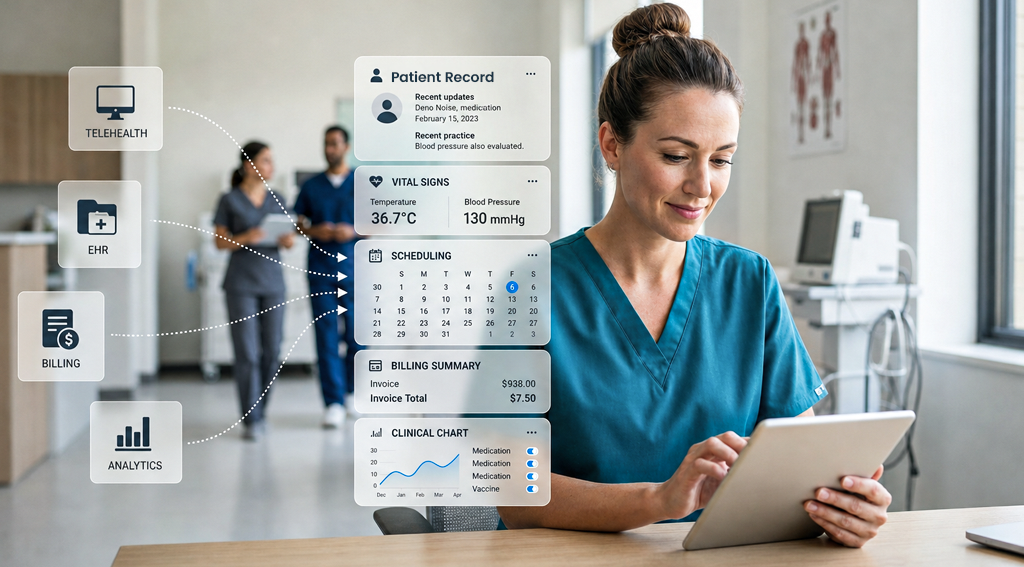
- EHR and Telehealth – Virtual care embedded directly into clinical workflows
- Revenue Cycle Management – Automated documentation-to-claim alignment and denial management
- Practice Management – Scheduling, eligibility verification, and patient engagement in one system
- Public Health Analytics & Reporting – Real-time dashboards aligned with UDS and other regulatory requirements
- Interoperability & Security – Cloud-based infrastructure designed for secure data exchange
When these capabilities run in a single ecosystem, organizations reduce vendor sprawl, improve visibility, and regain operational control.
Revenue Powers Sustainability
For public sector healthcare, modernization must deliver financial resilience.
Integrated telehealth programs can:
- Reduce no-shows
- Expand rural reach
- Improve patient retention
- Strengthen reimbursement accuracy
- Support Medicaid and value-based care initiatives
But when documentation, billing, and reporting are disconnected, revenue leakage follows, and ROI for digital expansion vanishes.
Integrated infrastructure ensures the alignment of clinical and reimbursement workflows — so expanded access translates into measurable financial performance.
Advancing Health Equity Through Unified Systems
Public-sector organizations serve some of the most medically underserved populations in the country. Addressing provider shortages, geographic barriers, and chronic disease disparities requires scalable coordination.
Unified platforms enable:
- Hybrid in-person and virtual care models
- Multi-site collaboration
- School-based and mobile clinic integration
- Proactive outreach powered by population-level insights
When digital access is embedded within core clinical infrastructure, equity initiatives become sustainable — not administratively overwhelming.
Beyond the Grant Cycle
Many digital initiatives begin with grant funding. Too often, they stall when funding sunsets or integration costs rise.
Consolidated platforms improve cost predictability, simplify vendor management, and support long-term scalability. Rather than layering additional tools every few years, organizations can invest in infrastructure designed to evolve alongside policy changes and reimbursement models.
This is the difference between modernization and true transformation.
The Future Is Integrated
Public health modernization is no longer optional. The real question is not whether to invest in digital care — but how to build it sustainably.
Organizations that win in the next decade will not be those with the most digital tools. They will be those with the most integrated infrastructure.
Digital health is consolidating — and that consolidation will set who thrives and who struggles.
CureMD delivers a unified ecosystem designed to support compliance, financial performance, and scalable public-sector transformation — today and into the next decade.
