
Public health agencies are absorbing more responsibility every year while budgets, headcounts, and time keep contracting. Workforce shortages, burnout, complex grant reporting, and outdated data workflows are pushing already understaffed teams past capacity. That is why the conversation around artificial intelligence (AI) in public health needs to shift. AI should not be positioned as a replacement for public health professionals or as Read more…
Health IT
The Healthcare Contact Center Is Broken AI Alone Won’t Fix It

Healthcare leaders are investing heavily in AI-powered contact centers—but most are solving the wrong problem. Faster call handling. Lower wait times. Better agent productivity. Those are improvements. But they’re not transformation. Because the real issue isn’t the call—it’s the workflow wrapped around it. The Real Problem Isn’t Volume—It’s Access Every patient interaction is a moment of risk: A missed call Read more…
Why Integrated Platforms Will Shape Public Sector Care in the Next Decade
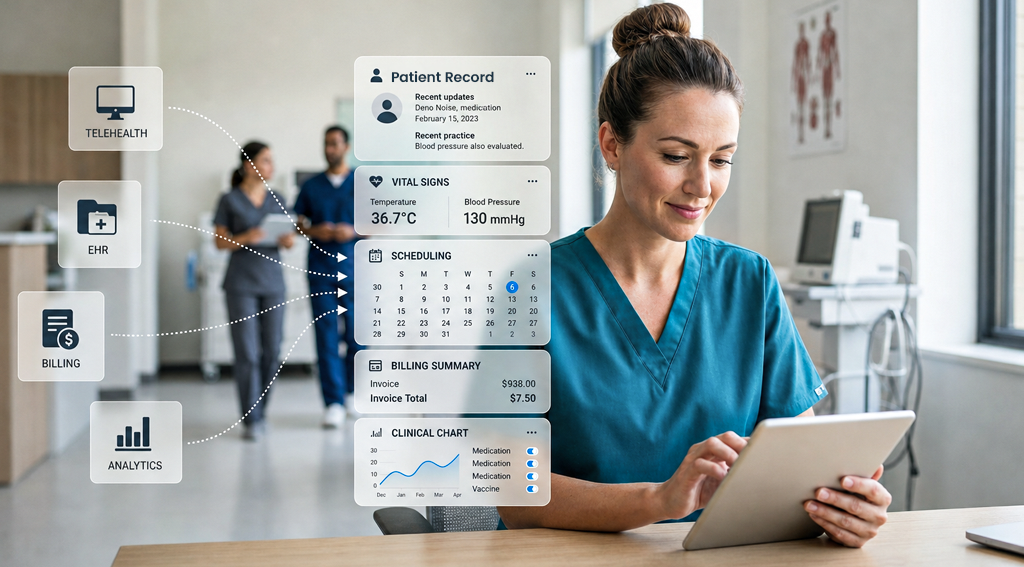
The Great Digital Health Consolidation Public Sector healthcare is entering a new phase. In recent years, health departments, FQHCs, rural clinics, and community providers raced to expand digital access: telehealth adoption surged; new systems were implemented, and emergency funding accelerated modernization efforts. It worked — access expanded. But expansion carried a cost. Today, many public health organizations manage patchwork of disconnected systems, overlapping vendors, and manual workflows — all of which strain already limited resources. Read more…
How Modern Patient Engagement Reduces No-Shows, Improves Collections & Saves Staff Time

A comprehensive guide for medical practices seeking digital solutions to their biggest operational challenges. The Harsh Reality Facing Medical Practices Every Day Your front desk is overwhelmed. The phones won’t stop ringing. Patients expect the same level of convenience as their Amazon Prime experience, but they get stuck in healthcare red tape instead. No-shows gut Read more…
AI Medical Scribes: A New Era for Clinical Documentation

Clinical documentation has long been one of the most exhausting, time-consuming aspects of medical practice. But now, with AI-powered medical scribes, those days are behind us – giving physicians more time for what really matters, taking care of patients, while at the same time improving the quality and speed of their documentation and cutting down Read more…
The $50B Rural Health Fund: What Really Matters (and What to Do Next)

A huge rural health fund just became real. It’s $50B over 5 years (FY26–FY30), with $10B/year and a single, one-time application. States submit once; CMS announces awards by December 31, 2025. If you lead an FQHC, HCCN/PCA, or a public health team, your state is already sketching its plan. The question is whether your projects Read more…
Workforce 2.0: Rebuilding Public-Health Talent Pipelines with AI & Cross-State Licensing

Vacancy rates over 25 % are hobbling U.S. health departments. By pairing AI “co-worker” tools with nurse and physician licensure compacts, agencies can fill skill gaps 60% faster, slash paperwork hours, and keep mission-critical programs alive. Table of Contents The 2025 Workforce Crisis AI as a Force-Multiplier, Not a Job Killer Cross-State Licensing: The Fast Lane Read more…
Cyber Shield 2030: Zero-Trust Tactics That Let Public Health Agencies Fight Ransomware

Ransomware is draining billions from U.S. health systems each year. A pragmatic, zero-trust security blueprint—backed by AI analytics, regional cost-sharing, and federal grants—can slash exposure time and recovery costs for even the smallest county health department. Table of Contents Why 2025 Is a Perfect Storm Zero Trust 101—Built for Lean Teams Step 1: Form a Shared Regional Read more…
Transforming Public Health: 5 AI-Powered Strategies That Boost Community Well-Being

Do you belong to one of the many public health departments juggling disease surveillance, chronic illness prevention, and community outreach—all while adapting to new mandates, diverse populations and reduced fundings? Keeping pace in this era of evolving threats, budget constraints, and the urgent need for timely data can be exhausting. The answer to not just Read more…
Changes to MIPS Reporting: What You Need to Know for 2025

The Merit-based Incentive Payment System (MIPS), a metric established by the Centers for Medicare and Medicaid Services (CMS), plays a critical role in determining reimbursement rates for healthcare providers. It evaluates physicians based on their performance in four key categories: quality, cost, improvement activities, and promoting interoperability. In 2025, several important changes affect MIPS reporting. Read more…